Physical AI · Autonomous driving
NVIDIA Alpamayo 2 Edge: Adaptive AI Reasoning for Autonomous Driving, Explained
How NVIDIA's compact reasoning model for self-driving works, how it runs on DRIVE AGX Thor, and how AlpaJudge scores and improves its driving explanations
By TheBestSuperintelligence Editorial TeamUpdated
- 2B-parameter model
- 160 to 190 ms on DRIVE AGX Thor
- Weights released November 10, 2026
- Sources read November 18, 2026
What is NVIDIA Alpamayo 2 Edge?
NVIDIA Alpamayo 2 Edge is a compact vision-language-action model for autonomous driving. It reads six cameras, explains its reasoning only when a scene needs it, and outputs a 6.4-second trajectory. NVIDIA reports 160 to 190 ms latency on DRIVE AGX Thor.
◈Key Takeaways (5)
- •Alpamayo 2 Edge is NVIDIA's compact vision-language-action model for in-vehicle driving, announced October 21, 2026, with weights released November 10, 2026.
- •Adaptive reasoning: it writes a reasoning trace when a scene needs one and emits a <NOMINAL> token for routine driving.
- •NVIDIA reports 160 to 190 ms from pixels to trajectory on DRIVE AGX Thor after optimization; the default weights were tested only on an H100 GPU.
- •AlpaJudge scores driving explanations and can be used to pick training data and as a reward in reinforcement learning.
- •The code is Apache 2.0, but the model weights use the separate OpenMDW-1.1 licence.
☰On this page (14 sections)
- 01.NVIDIA Alpamayo 2 Edge at a glance
- 02.Adaptive reasoning: the central idea in Alpamayo 2 Edge
- 03.How Alpamayo 2 Edge works: inputs, processing and outputs
- 04.Chain-of-Causation reasoning: explaining driving decisions
- 05.Optimizing Alpamayo 2 Edge for NVIDIA DRIVE AGX Thor
- 06.AlpaJudge: scoring the quality of driving explanations
- 07.Three ways to use AlpaJudge to improve driving models
- 08.Alpamayo 2 Edge vs Alpamayo 2 Super
- 09.The wider Alpamayo ecosystem around AlpaJudge and DRIVE AGX Thor
- 10.How developers can get started with NVIDIA Alpamayo 2 Edge
- 11.What Alpamayo 2 Edge means for autonomous driving
- 12.More questions about NVIDIA Alpamayo 2 Edge
- 13.Limits of this guide
- 14.Sources & Further Reading
NVIDIA Alpamayo 2 Edge at a glance
Alpamayo 2 Edge brings reasoning-based driving models closer to real-time operation inside the vehicle. NVIDIA announced it at GTC Berlin on October 21, 2026, and released the weights and a technical walkthrough on November 10, 2026.
- Developer
- NVIDIA
- Model type
- Vision-language-actionreasoning plus trajectory
- Size
- 2Bas marketed; 2.65B on the model card
- Target hardware
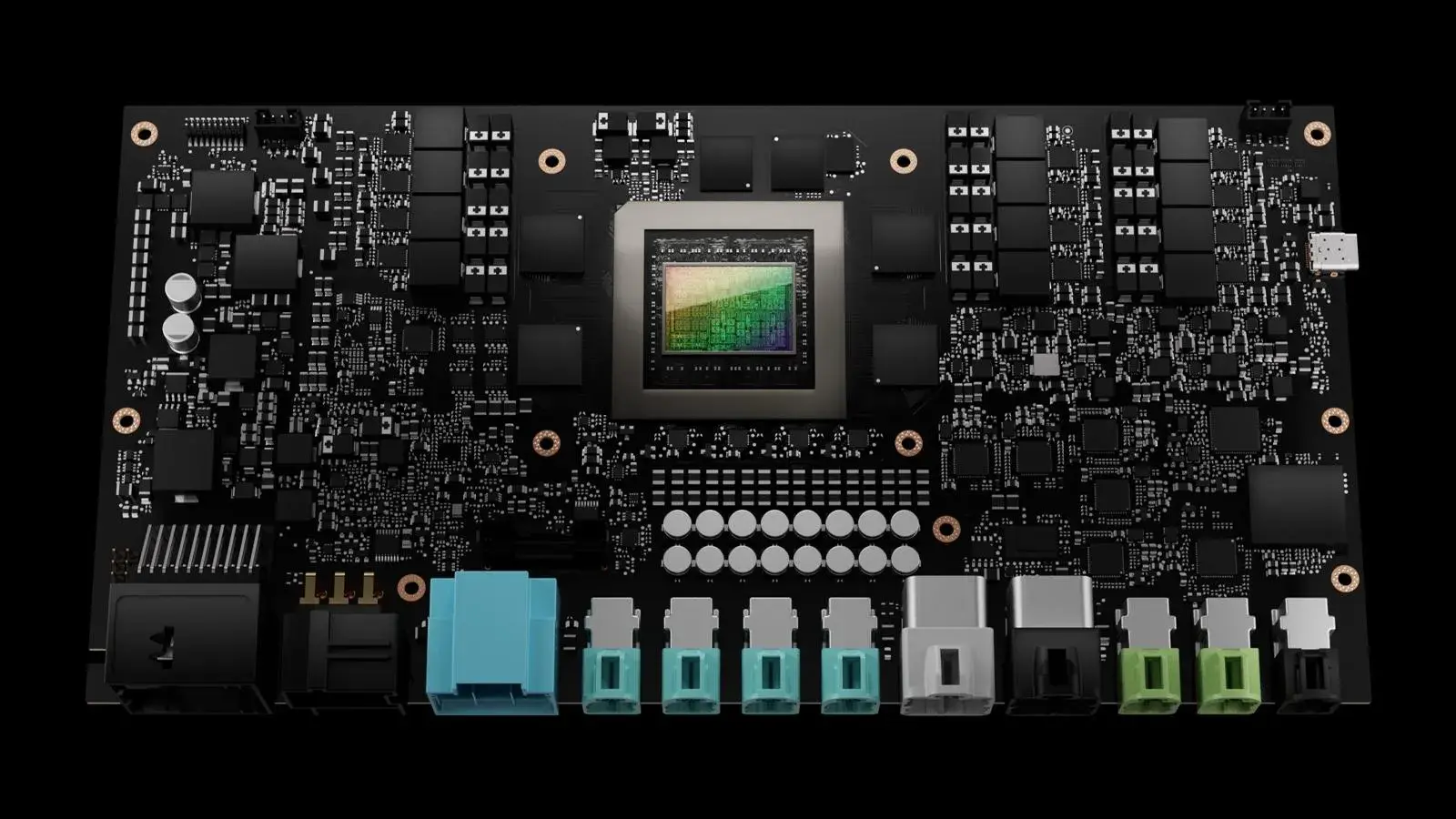
- DRIVE AGX Thor
- Latency on Thor
- 160 to 190 msNVIDIA's figure
- Trajectory output
- 64 poses6.4 seconds at 0.1 s steps
- Weights released
- Nov 10, 2026
- Licence
- Apache 2.0 codeOpenMDW-1.1 weights
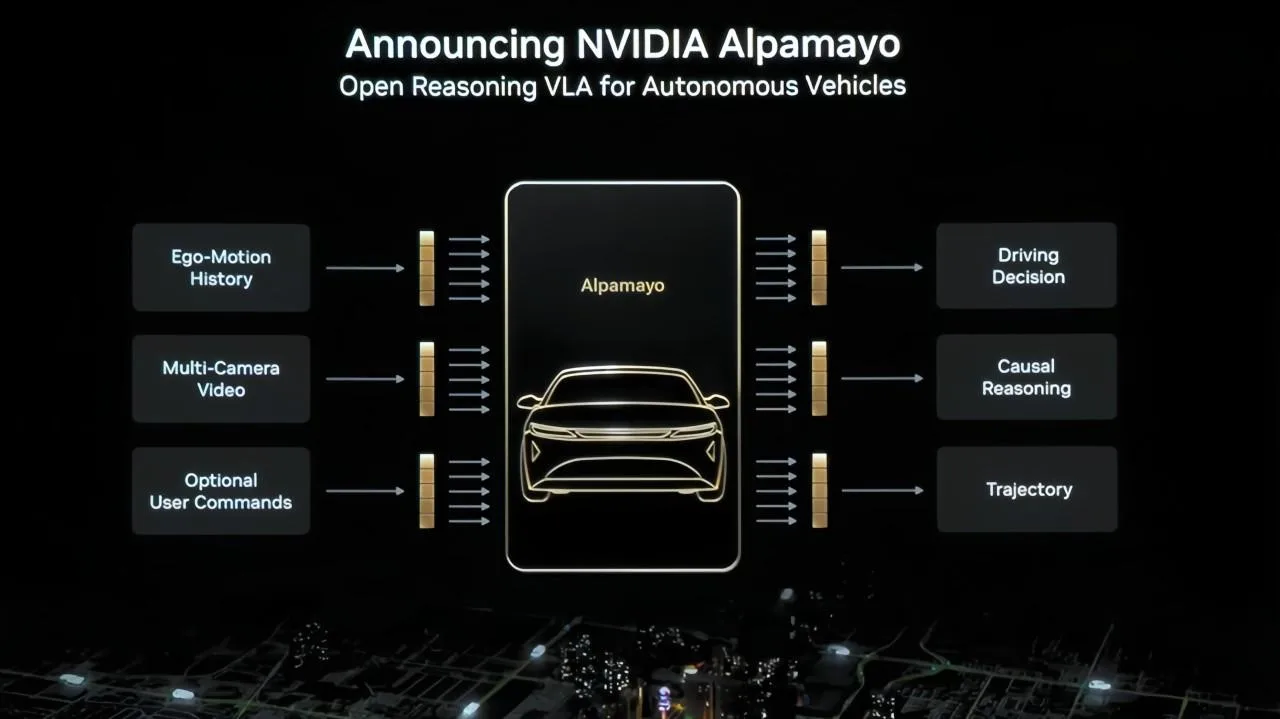
Unlike a conventional perception model that mainly identifies objects, lanes and obstacles, Alpamayo is designed to connect what the vehicle observes with why a driving action makes sense. It combines three capabilities:
- Vision: it understands multi-camera observations of the driving environment.
- Reasoning: it writes explanations that connect observed events, hazards and driving decisions.
- Action: it generates future vehicle trajectories from scene observations, motion history and a navigation instruction.
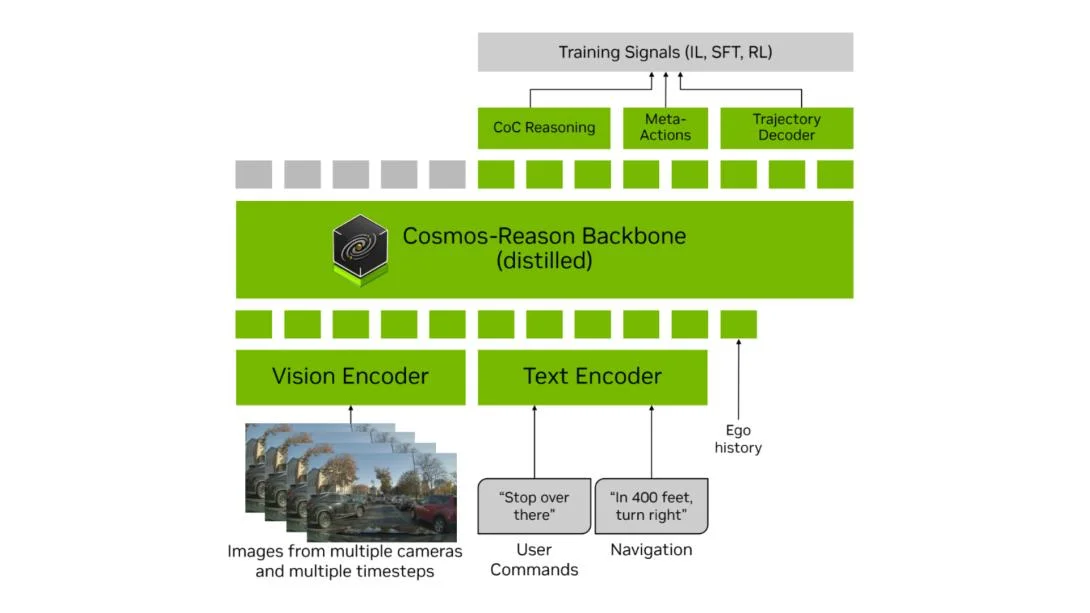
The model is built on the Nemotron-based reasoning backbone of NVIDIA Cosmos 3 Edge, paired with a diffusion action expert that generates the trajectory. Vendor-reported
How big is the model, exactly?
NVIDIA markets Alpamayo 2 Edge as a 2-billion-parameter model. Its own model card gives a more detailed count that adds up to about 2.65 billion.
The "2B" label matches the language model. The backbone as a whole is 2.45B, and the action expert adds 0.2B.
Adaptive reasoning: the central idea in Alpamayo 2 Edge
Reasoning models can spend a lot of computation writing explanations even when the task is simple. In a vehicle, unnecessary reasoning uses resources the onboard computer needs elsewhere.
Alpamayo 2 Edge writes detailed reasoning when the situation calls for it and can skip it during routine driving. NVIDIA says the model sometimes produces a special <NOMINAL> token in place of a reasoning trace, "indicating routine driving and conserving inference compute". Vendor-reported
- Clear road, steady lane
- <NOMINAL> token
- Trajectory
- Construction zone or crossing pedestrian
- Reasoning trace
- Trajectory
| Driving situation | Expected model behavior |
|---|---|
| Clear road and steady lane keeping | A nominal response in place of extended reasoning |
| Approaching a complex intersection | Analyze surrounding traffic and possible maneuvers |
| Pedestrian approaching a crosswalk | Evaluate the pedestrian's position and likely movement |
| Construction zone | Interpret temporary road boundaries and obstacles |
| Traffic officer directing vehicles | Interpret the scene and choose a fitting driving decision |
| Unusual or ambiguous situation | Spend more reasoning on understanding the situation |
The table is our illustration of the idea; NVIDIA does not publish a list of which scenes trigger reasoning. The aim is not to maximize reasoning but to match computation to the demands of the scene, which is how the model balances decision quality against latency.
How Alpamayo 2 Edge works: inputs, processing and outputs
The model processes several streams of information, not a single image.
| Input | Purpose |
|---|---|
| Six camera views, 22 frames per observation | Observe the surroundings and how they change over time |
| 20 historical ego poses (the last 1.9 seconds) | Understand the vehicle's recent movement and orientation |
| Navigation instruction, as text | Understand the intended route or maneuver |
| Optional visual question | Scene-specific question answering, on a separate inference path |
The front wide and front telephoto cameras contribute five frames each and the other four cameras three each, so the model keeps more detail where it matters most. Vendor-reported
The model outputs:
- Chain-of-Causation reasoning traces, or a
<NOMINAL>token. - 64 future waypoints covering 0.1 to 6.4 seconds at 0.1-second intervals.
- Several trajectory candidates when configured, each with its own reasoning text.
- Answers to visual questions, through the separate path that skips trajectory generation.
The 6.4-second sequence is a prediction, not a guarantee that the vehicle will execute the whole trajectory without replanning.
What it was trained on and how it scores
The model card lists roughly 115,000 hours of multi-camera driving video and about 3.7 million Chain-of-Causation reasoning traces, some of them synthetic. NVIDIA's reported results:
875 scenarios, three rollouts each, in NVIDIA's own simulator. On open-loop prediction NVIDIA reports a minADE of 0.53 meters against 1.68 meters for the same rival (lower is better).
These are NVIDIA's tests of NVIDIA's model in NVIDIA's simulator. We found no independent evaluation.
Chain-of-Causation reasoning: explaining driving decisions
A defining feature of the Alpamayo family is Chain-of-Causation (CoC) reasoning. The model does not only produce a trajectory. It writes a human-readable explanation of the scene and the causes behind its proposed maneuver.
Take a hypothetical construction zone. A conventional perception system might report four separate detections: barriers, lane markings, a pedestrian, an obstruction. A reasoning-based model aims to connect them:
- 1Lane blockedConstruction barriers partly obstruct the normal driving lane.
- 2Less roomThe available road space is narrower than usual.
- 3PedestrianA person is approaching the temporary crossing area.
- 4Two constraintsThe vehicle must account for both the road geometry and the pedestrian.
Our illustration, not model output.
This gives developers another source of information for investigating model behavior, reviewing training examples and spotting wrong explanations.
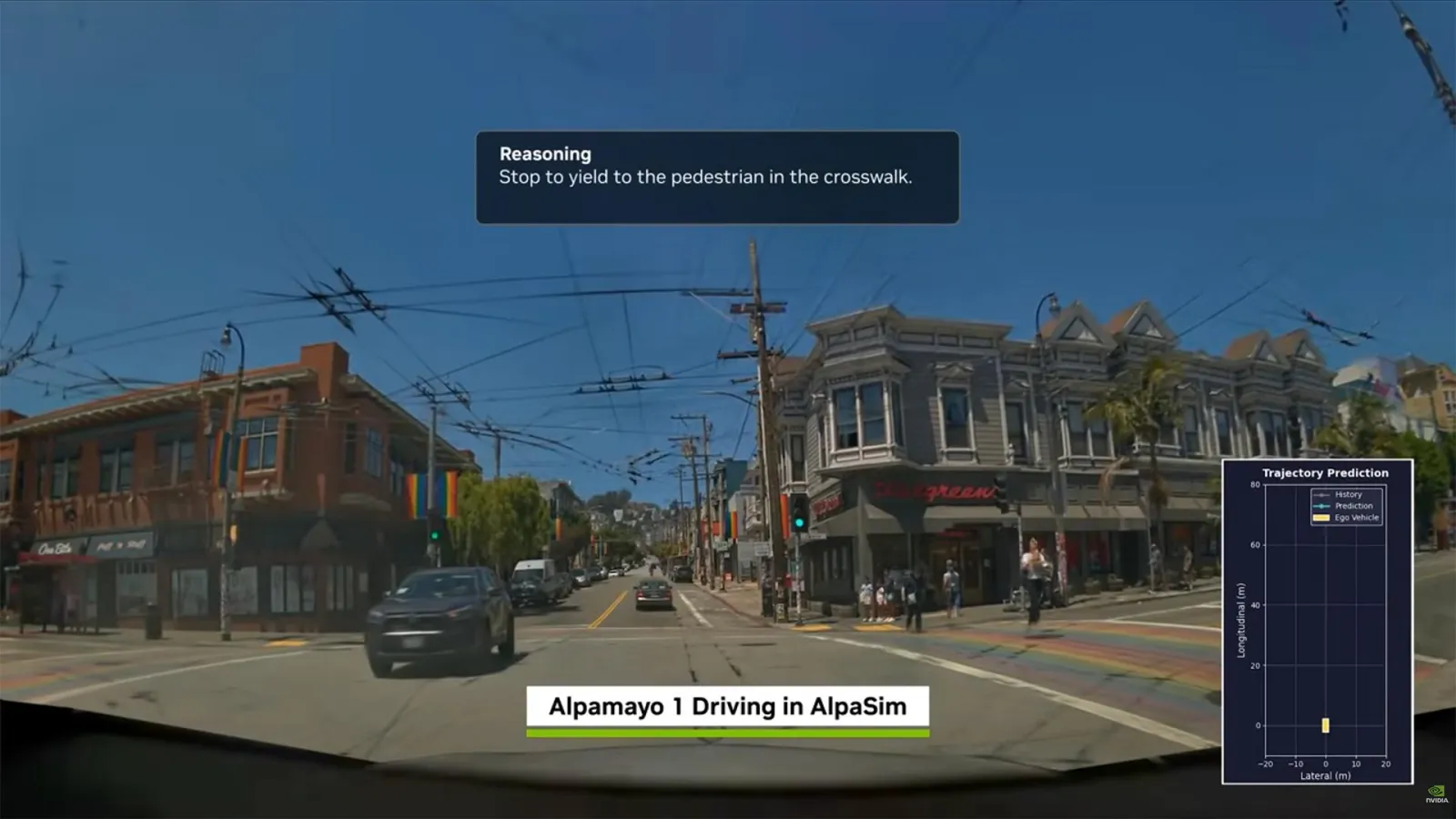
A fluent explanation is not proof that the underlying decision is correct. The reasoning must be checked against visual evidence, actual vehicle behavior and independent safety metrics.
Optimizing Alpamayo 2 Edge for NVIDIA DRIVE AGX Thor
Deploying the model in a vehicle is not a matter of downloading the checkpoint and running it. It has to fit limits on latency, memory, power, heat, numerical precision and real-time scheduling, and integrate with the vehicle's software.
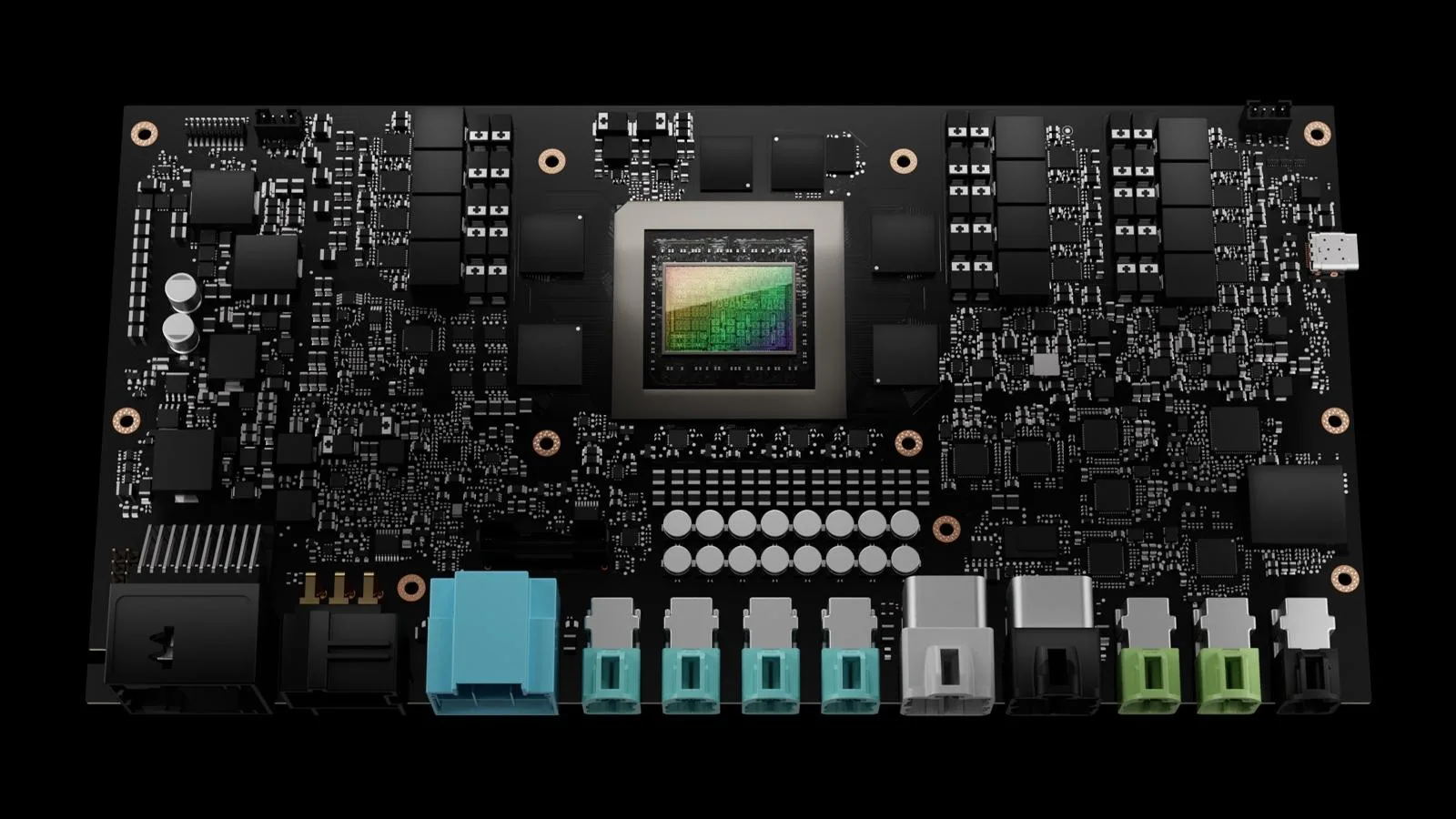
NVIDIA publishes an optimization recipe for DRIVE AGX Thor:
- Stage checkpoint and DFlash2 drafter
- Calibrate FP8 scales
- Export ONNX graphs
- Build TensorRT engines
- Run and validate
| Technology | Role |
|---|---|
| DRIVE AGX Thor | Target automotive computer |
| NVIDIA TensorRT with TensorRT Edge-LLM plugins | Optimized model execution |
| ONNX | Model graph export |
| FP8 | Reduced-precision inference |
| DFlash2 | Draft model for speculative decoding |
| BF16 | Reference precision that the optimized outputs are compared against |
Faster inference is useful only if the optimized model still produces sound reasoning and trajectories, so the recipe compares optimized outputs with a BF16 PyTorch reference built from identical inputs and seeded action noise.
What performance does NVIDIA report on DRIVE AGX Thor?
- Pixel-to-trajectory latency
- 160 to 190 msNVIDIA reference recipe
- Partner-reported rate
- 10 HzEmbedl, in under 48 hours
- Reference hardware
- DRIVE AGX Thor-X
- Software
- DRIVE OS 7.2.7.0CUDA 13.4, TensorRT 11.3.1.9
These are two different results and should not be merged. NVIDIA's recipe reports 160 to 190 ms depending on the amount of reasoning. Vendor-reported Embedl's chief executive separately said his company made the model "run at 10 Hz on AGX Thor" in less than 48 hours, which is a partner statement quoted in NVIDIA's post, not an NVIDIA benchmark. Partly comparable A 10 Hz rate means a 100 ms cycle, so the two figures describe different configurations. NVIDIA's press release also describes the model as "designed to run at 10Hz".
The default weights are a different matter. The model card says they were tested on a single NVIDIA H100 data-center GPU and that other GPUs have not been validated.
AlpaJudge: scoring the quality of driving explanations
A model can produce a plausible explanation while making a wrong driving decision, or a reasonable trajectory with an incomplete explanation. AlpaJudge is NVIDIA's evaluation and reward model for the explanation side, released in two versions.
| AlpaJudge-RB (reference-based) | AlpaJudge-RF (reference-free) | |
|---|---|---|
| Inputs | Driving question, reference answer, candidate answer | Three front-wide frames, three front-telephoto frames, the vehicle's past and future meta-actions, candidate rationale |
| Output | One alignment probability from 0 to 1 | Five rubric probabilities plus action, component and overall scores |
| What it tells you | How closely the candidate matches the reference | Whether the explanation fits the scene and the action |
| Main caveat | It does not check the scene independently | A high score does not replace collision and trajectory metrics |
AlpaJudge-RF scores five dimensions:
| Dimension | What it evaluates |
|---|---|
| Action agreement | Whether the described action matches the action evidence |
| Action safety | Whether the proposed action is safe |
| Component grounding | Whether the parts of the explanation are grounded in the scene |
| Component completeness | Whether important scene elements are included |
| Causal consistency | Whether observations and actions are connected coherently |
NVIDIA documents how the scores combine:
- Action = p_match × (1 + p_safe) / 2
- Component = the mean of p_grounded, p_complete and p_causal
- Overall = 0.6 × Action + 0.4 × Component
So the action counts for more than the wording, and an unsafe action is penalized even when it matches the reference.
Three ways to use AlpaJudge to improve driving models
1. Evaluate Alpamayo 2 Edge reasoning
Run the model on a clip from NVIDIA's PhysicalAI-AV dataset, extract its Chain-of-Causation explanation, and score it with AlpaJudge-RF, plus AlpaJudge-RB where an expert reference exists. Record the results beside trajectory and safety metrics.
NVIDIA's example notebook uses a fixed construction-zone sample at 5.1 seconds and prints an RB alignment of 0.999 and an RF overall score of 0.842. Those are smoke-test outputs on a hand-written example, not accuracy figures for the model.
2. Select better training examples
Not every training example teaches the model the same amount.
| Score band | Possible meaning | NVIDIA's advice |
|---|---|---|
| Low | Wrong labels, failed rollouts, hard scenarios | Review before discarding |
| Middle | Often the most informative data | Prioritize for training |
| High | Scenes the model already explains well | Reduce redundant sampling where appropriate |
Low-scoring examples should not be deleted automatically. They may be rare but important safety scenarios, and removing them could make the model worse at unusual situations. NVIDIA recommends setting thresholds on a development split and keeping the held-out evaluation split untouched.
3. Improve models through reinforcement learning
NVIDIA's public reinforcement-learning recipe shows AlpaJudge as part of a reward function, combined with trajectory error and comfort metrics. AlpaJudge-RB adds a reward when a reference reasoning trace exists, so training optimizes the explanation as well as the path.
NVIDIA recommends keeping the trajectory gate and logging each reward component, so a model cannot earn a high reward for a convincing explanation of a wrong trajectory.
- Judge-scored reasoning quality
- +10.2%with the AlpaJudge reward
- Human-evaluated reasoning quality
- +11.4%same experiment
Both figures come from a chart caption in NVIDIA's post, for one experiment on a model based on Alpamayo 2 Super. Vendor-reported They are not a general promise for every Alpamayo model or training setup.
Alpamayo 2 Edge vs Alpamayo 2 Super
The two models have different jobs in NVIDIA's driving stack.
| Characteristic | Alpamayo 2 Edge | Alpamayo 2 Super |
|---|---|---|
| Parameters | 2B | 34B |
| Primary role | In-vehicle inference | Foundation model for development |
| Reasoning | Adaptive | Larger-scale reasoning |
| Trajectory generation | Yes | Yes |
| Role in training | Learns from Super's labels | Auto-labels Chain-of-Causation reasoning |
| Deployment target | DRIVE AGX Thor | Development and training workflows |
| Licence | Apache 2.0 code, OpenMDW-1.1 weights | Described by NVIDIA as commercially licensed |
The link between them matters most: NVIDIA trains Edge by offline distillation on reasoning labels that Alpamayo 2 Super generates. The small model learns from the large one while staying within the limits of an onboard computer.
The wider Alpamayo ecosystem around AlpaJudge and DRIVE AGX Thor
Alpamayo 2 Edge is one part of a larger set of models, datasets, simulators and safety technology.
| Component | Purpose |
|---|---|
| Alpamayo 2 Edge | Compact reasoning model for in-vehicle operation |
| Alpamayo 2 Super | Larger reasoning foundation model |
| AlpaJudge | Reasoning evaluation and reward model |
| AlpaSim | Closed-loop driving simulation |
| AlpaGym | Closed-loop reinforcement learning |
| NVIDIA Cosmos | Foundation models for physical AI |
| Physical AI Open Datasets | Real-world multi-sensor driving data |
| Omniverse NuRec | Reconstruction of driving scenes |
| DRIVE AGX Thor | In-vehicle computer |
| NVIDIA Halos | Full-stack safety system |
| NVIDIA Hyperion | Common computing and sensor architecture for vehicles |
The development loop, as NVIDIA presents it:
- Real-world driving data
- Scene reconstruction and simulation
- Training and reasoning labels
- Evaluation with AlpaJudge
- Edge deployment on Thor
- New data
NVIDIA's October 21, 2026 press release names carmakers and mobility companies building on this stack, among them Mercedes-Benz, Volvo Cars, Lucid, Volkswagen Group, Porsche and Uber. For the hardware side of this story see our guides to AI chip makers and edge and embedded AI, and for robots that act in the physical world, robotics middleware.
How developers can get started with NVIDIA Alpamayo 2 Edge
| Resource | What you get |
|---|---|
| Alpamayo 2 Edge on GitHub | Source code, inference examples, setup instructions and notebooks |
| Alpamayo 2 Edge on Hugging Face | The model checkpoint and model card |
| AlpaJudge on Hugging Face | The reference-based and reference-free evaluator checkpoints |
| NVIDIA's technical walkthrough | Thor optimization and the AlpaJudge workflows |
| NVIDIA Alpamayo platform page | The wider model and software family |
For the public PyTorch inference example, NVIDIA's repository lists:
- A Linux host with an NVIDIA GPU that supports BF16, and a compatible CUDA driver.
- At least 16 GB of GPU memory recommended.
- Python 3.12 and the
uvenvironment manager. - A Hugging Face account with access to the checkpoint and to the PhysicalAI-Autonomous-Vehicles dataset, whose terms you must accept.
- About 5.3 GB of disk space for the model. FlashAttention 2 is optional.
These are requirements for a development machine, not a specification for a production vehicle. Thor deployment needs the separate optimization recipe.
What Alpamayo 2 Edge means for autonomous driving
- Reasoning models are moving into the vehicle. A compact, optimized model makes it possible to use reasoning within the limits of onboard hardware.
- Explanations become part of evaluation. Developers can check whether the system identifies hazards and explains its decisions, not only whether the trajectory is right.
- Evaluation becomes part of training. AlpaJudge turns reasoning quality into something that can be measured and used as a training signal.
- Simulation and real data are tied together. Real driving scenes can be reconstructed, tested and used to improve models.
- Edge efficiency is a design requirement. A model that is strong in research is not automatically fit for a production vehicle.
The broader direction is that physical AI is moving from recognizing the world toward systems that interpret situations, act, explain their decisions and improve from structured feedback. Alpamayo 2 Edge is one of NVIDIA's concrete attempts to make that practical. Whether it works outside NVIDIA's own tests is still an open question.
More questions about NVIDIA Alpamayo 2 Edge
What hardware does Alpamayo 2 Edge run on?
It is designed for in-vehicle deployment on NVIDIA DRIVE AGX Thor, using NVIDIA's recipe of FP8 calibration, ONNX export and TensorRT. The default weights run as a PyTorch model on NVIDIA GPUs and were tested by NVIDIA on an H100.
What is the difference between AlpaJudge-RB and AlpaJudge-RF?
AlpaJudge-RB is reference-based: it compares a candidate explanation with an expert reference. AlpaJudge-RF is reference-free: it scores a candidate explanation against camera frames and the vehicle's actions.
What is the difference between Alpamayo 2 Edge and Alpamayo 2 Super?
Edge is the small model for efficient in-vehicle inference. Super is a 34-billion-parameter foundation model used for heavier reasoning and for generating the training labels that Edge learns from.
Can Alpamayo 2 Edge drive a car on its own?
It generates driving reasoning and trajectories, but that does not make it a complete or approved self-driving system. NVIDIA's model card says integrating such models "requires additional testing using use-case-specific data to ensure safe and effective deployment". Real-world use needs vehicle integration, independent safeguards, validation and regulatory approval.
Limits of this guide
No independent benchmark of Alpamayo 2 Edge exists yet, and simulator results do not guarantee road performance. A high AlpaJudge score is not a safety validation. NVIDIA's post gives two different figures for AlpaGym's driving gain (48.9% in its summary, 128.5% in the body), so we quote neither. We did not read the separate AlpaJudge repository or the Thor recipe code.
Sources & Further Reading
| Claim | Source | Section or date |
|---|---|---|
| Adaptive reasoning, the NOMINAL token, Cosmos 3 Edge backbone, Thor recipe, 160 to 190 ms, reference configuration, Embedl quote, AlpaJudge inputs, outputs, formulas and workflows, 10.2% and 11.4% gains, comparison with Qwen-Drive-1.0 | Running AV Reasoning Models Within Onboard Compute and Latency Limits (NVIDIA) | 2026-11-10, by Marco Pavone and Boris Ivanovic; read 2026-11-18 |
| Parameter breakdown, camera frames, ego poses, 64 waypoints, training data, AlpaSim and open-loop results, H100 test hardware, licences, release date | Alpamayo 2 Edge model card (Hugging Face) | Released 2026-11-10; read 2026-11-18 |
| Code licence, weights licence, system requirements, 5.3 GB checkpoint, dataset access | NVlabs/alpamayo2-edge (GitHub) | README, read 2026-11-18 |
| AlpaJudge-RB and AlpaJudge-RF checkpoints, inputs and outputs, licences | AlpaJudge model card (Hugging Face) | Undated, read 2026-11-18 |
| Alpamayo 2 Super size (34B) and licensing, AlpaSim, AlpaGym, datasets, Halos | NVIDIA Alpamayo platform page | Undated, read 2026-11-18 |
| Announcement of Alpamayo 2 Edge, "designed to run at 10Hz", Hyperion, NuRec, named carmakers | European Mobility Leaders Build Safe Vehicles and Robotaxi Fleets on NVIDIA Hyperion (NVIDIA) | 2026-10-21, GTC Berlin; read 2026-11-18 |
Frequently asked questions
What is NVIDIA Alpamayo 2 Edge?
NVIDIA Alpamayo 2 Edge is a compact vision-language-action model for autonomous driving. It reads six cameras, explains its reasoning only when a scene needs it, and outputs a 6.4-second trajectory. NVIDIA reports 160 to 190 ms latency on DRIVE AGX Thor.
What is adaptive reasoning in Alpamayo 2 Edge?
Adaptive reasoning lets the model write a detailed reasoning trace when a driving situation requires it and skip it during routine driving. NVIDIA says the model sometimes produces a special <NOMINAL> token in place of a reasoning trace, which signals routine driving and saves inference compute.
How fast is Alpamayo 2 Edge on DRIVE AGX Thor?
NVIDIA reports 160 to 190 milliseconds from pixels to trajectory for its optimized reference recipe, depending on how much reasoning the scene needs. Separately, the company Embedl said it ran the model at 10 Hz on AGX Thor. These are different configurations, and neither is an independent test.
What is AlpaJudge?
AlpaJudge is NVIDIA's evaluation and reward model for driving explanations. AlpaJudge-RB compares a candidate explanation with an expert reference. AlpaJudge-RF needs no reference and scores the explanation against camera frames and the vehicle's actions on five rubrics.
Is Alpamayo 2 Edge open source?
Partly. The inference code on GitHub is under the Apache 2.0 licence. The model weights on Hugging Face are released under a different licence, OpenMDW-1.1, and running the examples also requires accepting the terms of NVIDIA's PhysicalAI-Autonomous-Vehicles dataset.
How we sourced this. We read NVIDIA's technical post, model cards, GitHub repository and press release on 2026-11-18. Every performance figure is NVIDIA's or a named partner's. We did not run the model. Methodology